
myMirau: an AI agent on company data, no ERP changes
A manufacturing company queries its own data in natural language with myMirau: read-only access, no changes to the ERP and a verifiable cycle for every request.
Case study · Manufacturing
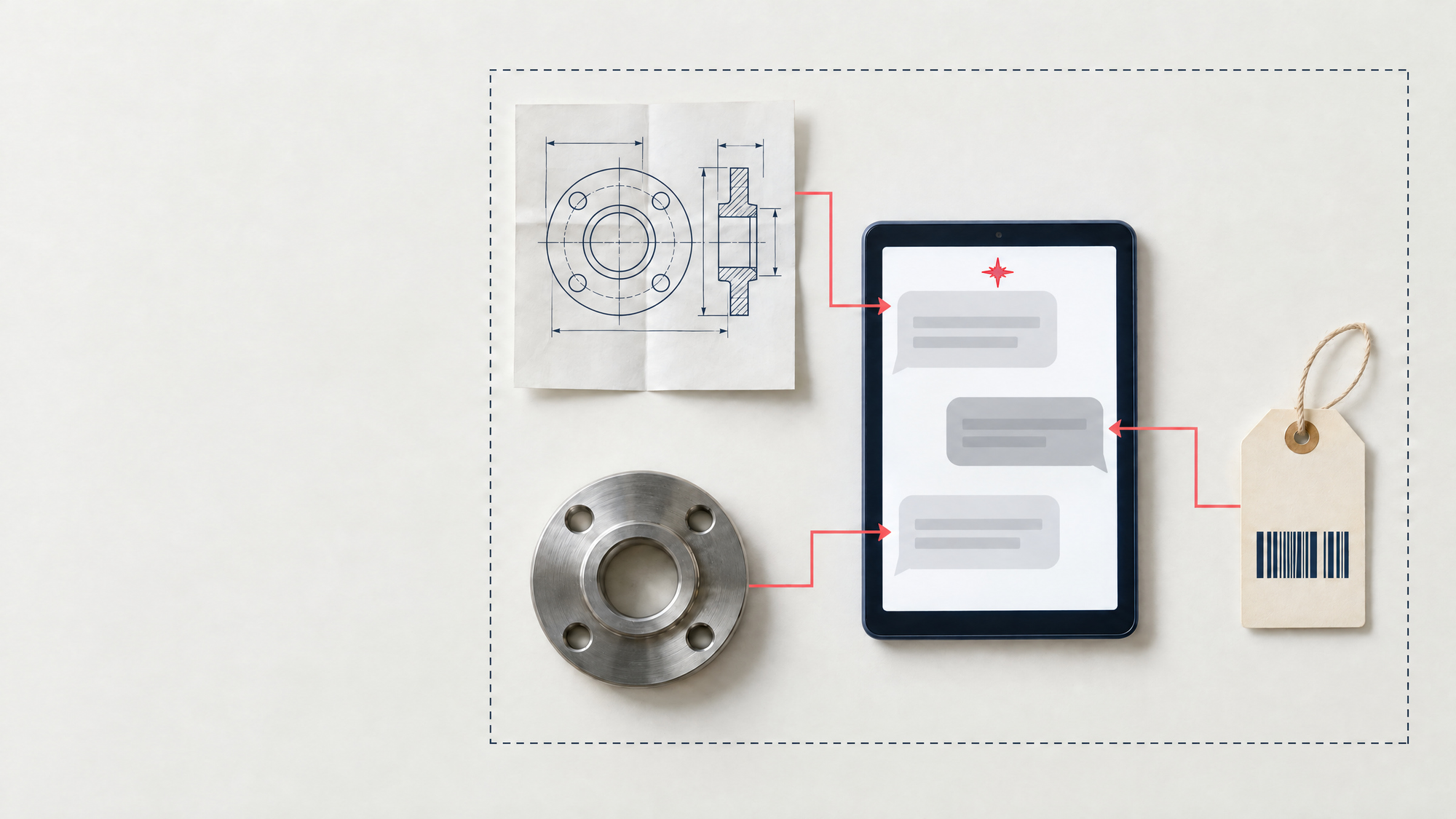
Ask the ERP a question, get an answer: no new software, no changes to the ERP, no courses.
- Client
- A manufacturing company: orders, inventory, production, customers, engineering
- Access
- Inside the company network, with no internet exposure
- Service
- Data Agents, available to other companies
Letting people talk to the data in their ERP is a goal many companies share, and few reach it quickly. The usual route means replacing the ERP or retraining everyone, and it is rarely short. A manufacturing company took another route with myMirau, the conversational agent developed by Siderius: a few months, no ERP replacement and no courses for employees, who simply write as they speak.
Two choices made this possible, one technical and one of method.
The technical choice: no intervention on the ERP
myMirau answers questions in natural language on the company’s real data: orders, inventory, production, customers, engineering. Behind the chat, an orchestrated system works in three steps: it understands the question and routes it to the right area, queries the data, and returns a readable answer.
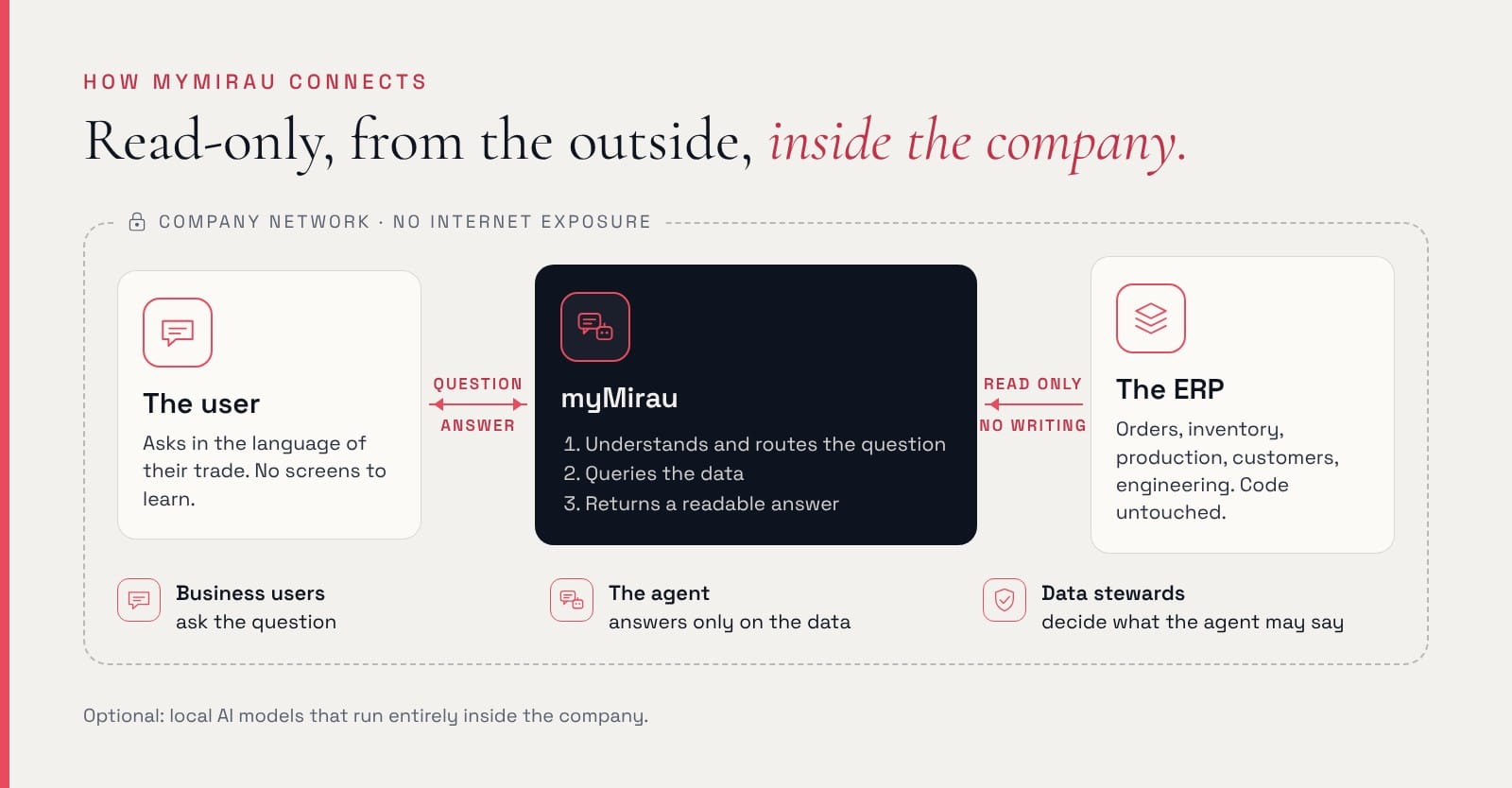
No code changes, no modules installed, no customisation: the agent reads from the outside and cannot write anything. The ERP keeps working as before, with its own updates and vendors. For the client this means no operational risk and no dependence on whoever maintains the ERP; for us, integration becomes a matter of understanding the data rather than modifying software.
The method: a structured dialogue
Technical integration is the short part. The real work is the dialogue with the client, which we treat as a fixed cycle, identical for every request. For a single question it may look excessive; it becomes necessary once every employee and partner enters the process.
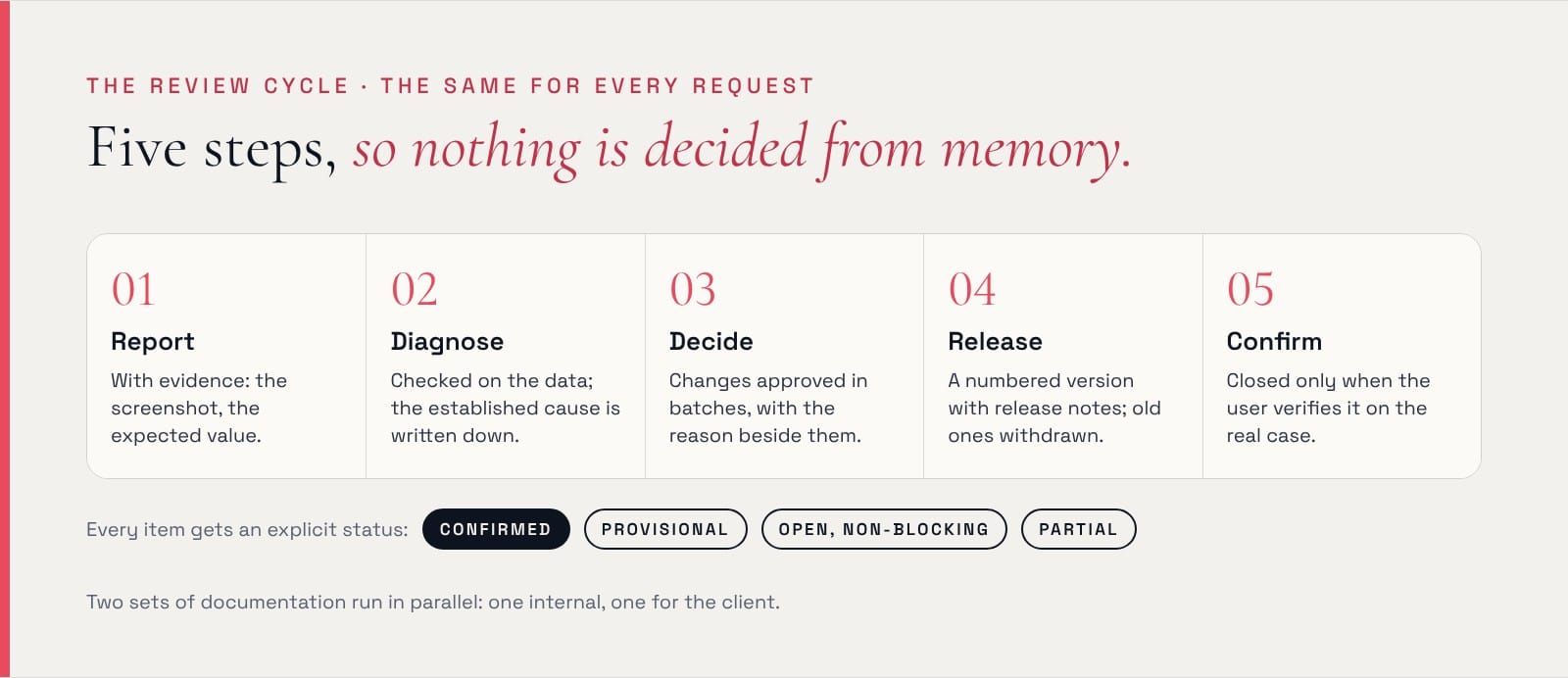
At the centre are the data checks: a proposed query, its result, a reasoned decision. Two examples show why it matters.
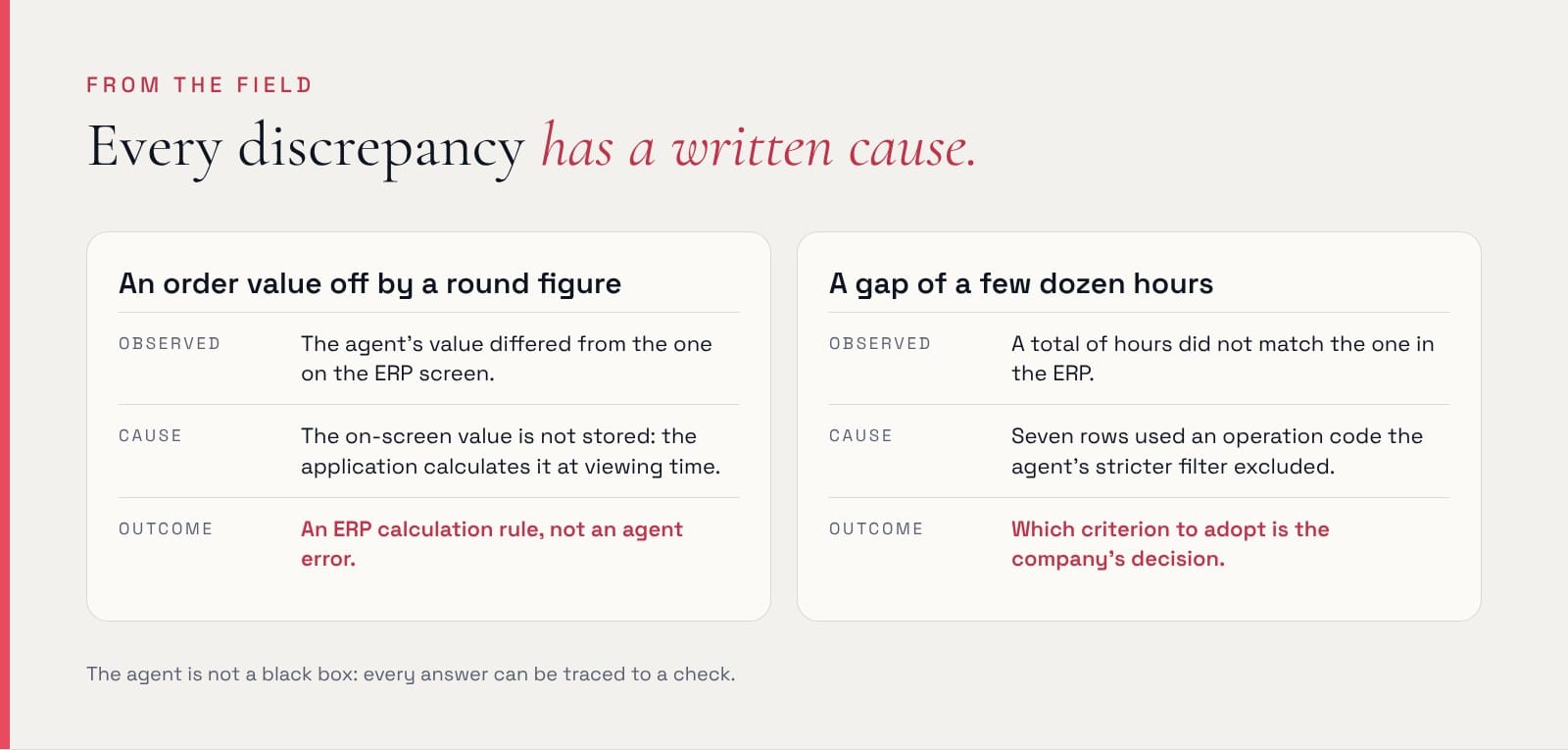
The result is an agent that is not a black box: every answer can be traced to a check, and every discrepancy with the ERP has a written cause. This is what lets a large organisation, with many people involved, trust what it reads.
Why myMirau
The name comes from optics. The Mirau objective, patented by André Henri Mirau in 1952, is used in microscopes to measure the shape of a surface: a small reference mirror sits at the centre of the lens, and the light returning from the surface is compared with the light returning from that mirror.1 The agent works the same way: every answer is compared with a reference, the data in the ERP. In the logo, the reference mirror is the Siderius star.
People and machine in the same system
The ERP records; the agent puts those who use the data in conversation with those who look after it. Business users ask, the agent answers strictly on the data, and data stewards decide what it may say. It is a practical instance of what Thomas Malone calls a supermind: intelligence as a property of the system of people and machines, not of the model alone.2
The division of labour matches early evidence on generative AI. In an experiment with 758 Boston Consulting Group consultants, GPT-4 improved speed and quality on tasks within the model’s reach, while on tasks outside it the likelihood of a correct answer fell by 19 percentage points.3 Deciding what the agent may say, and who verifies it, keeps every question on the right side of that frontier.
The service: Data Agents
Data Agents is the Siderius service for companies that want their people to query company data directly. myMirau is one implementation; the method is the same in every project.
- Data mapping. Where information lives, how it is calculated, who answers for its meaning.
- Read-only connection. From the outside, inside the company network, existing systems untouched.
- Agent configuration. Routing by area, query rules, limits on what it may answer.
- Review cycle. The five steps, with documented statuses and versions.
We have carried out other projects of this kind, in some cases with local AI models running entirely inside the company, in others for a larger number of users. What stays constant is the method.
Want your people to work directly with your data? In a first conversation we establish which data to start from, which constraints apply and how to measure the result. Write to innovation@adsiderius.com.
Frequently asked questions
Does our ERP need to change?
Does our data leave the company?
Do employees need training?
How do we know the answers are right?
Why is it called myMirau?
Project card. Project: myMirau · Client: a manufacturing company · Year: 2026 · Scope: data mapping, read-only ERP connection, conversational agent, review cycle and documentation · Deployment: inside the company network · Service: Data Agents
Talk to your data. Tell us about your systems: innovation@adsiderius.com
Siderius S.r.l. Società Benefit · Via Roma 50, 36070 Trissino (VI), Italy · adsiderius.com
Sources and references
- Mirau, A. H. (1952). Interferometer. U.S. Patent 2,612,074. patents.google.com/patent/US2612074
- Malone, T. W. (2018). Superminds: The Surprising Power of People and Computers Thinking Together. Little, Brown and Company.
- Dell’Acqua, F., McFowland, E., Mollick, E. R., et al. (2023). Navigating the Jagged Technological Frontier: Field Experimental Evidence of the Effects of AI on Knowledge Worker Productivity and Quality. Harvard Business School Working Paper 24-013. ssrn.com/abstract=4573321