
PPWR compliance: the Siderius method and the Zanin 1895 case
Regulation (EU) 2025/40 requires companies to prove what they declare. A compliance system built on the process, with AI where it adds value and fixed rules where the law decides.
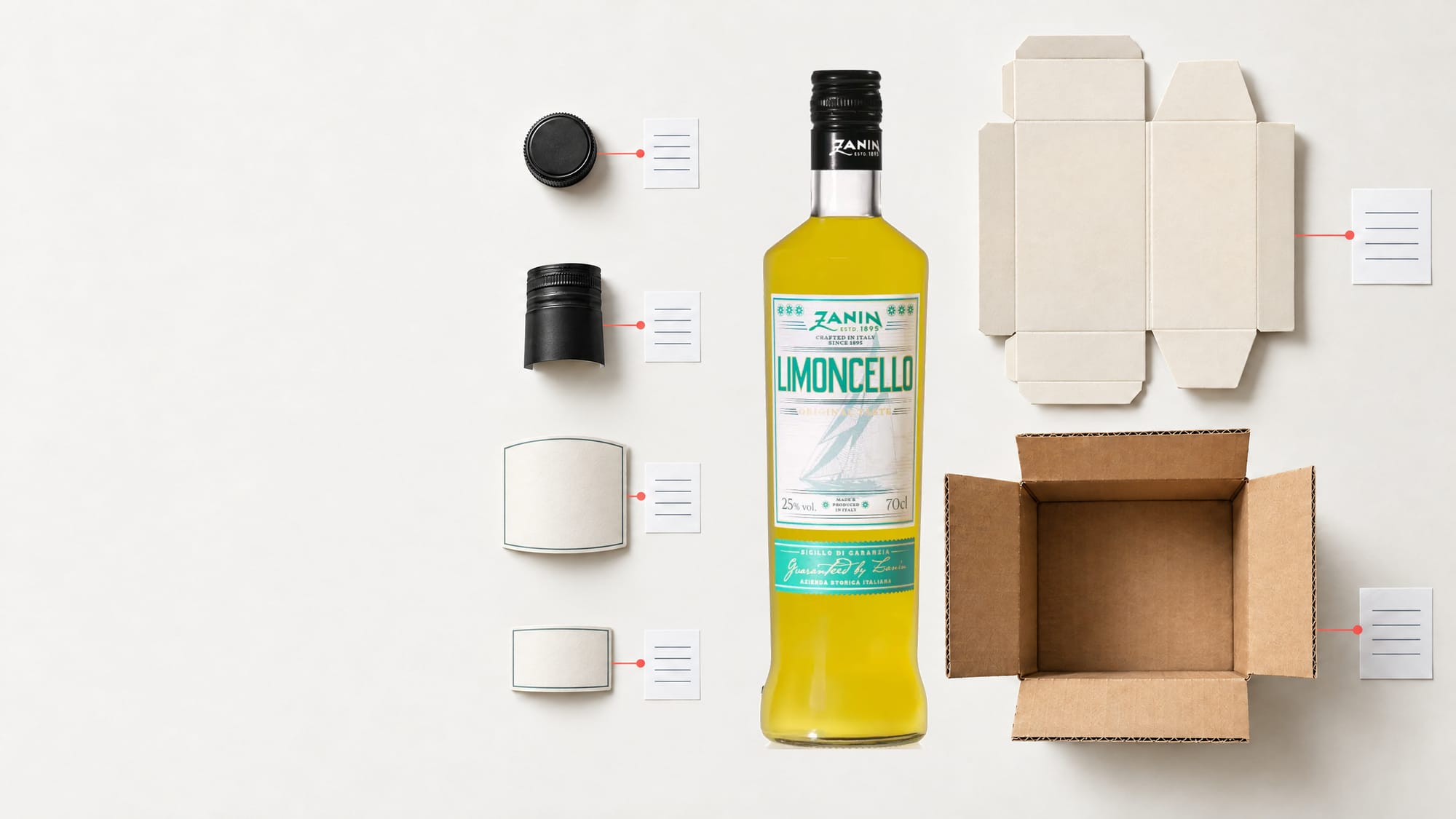
Case study · Zanin 1895
Packaging compliance you can prove: every claim traced to a document, a figure and a person.
- Client
- Distilleria Zanin 1895
- Service
- Packaging Compliance, now open to other companies.
- Method
- AI reads and drafts, fixed rules calculate, people decide.
Since 12 August 2026, Regulation (EU) 2025/40 on packaging and packaging waste has applied in every Member State, with no national transposition.3 Anyone placing packaging on the market must draw up an EU declaration of conformity and keep the technical file behind it. Compliance is a matter of evidence: every statement must lead back to a document, a data point and a person who answers for it.
With Distilleria Zanin 1895 we built a system that makes this chain verifiable. The same system is now available as a service to other companies.
An obligation that spans the supply chain
The manufacturer signs the declaration, but the information comes from producers and material suppliers, and inside the company from purchasing, quality, production and legal, each with its own formats. And 2026 is only the first layer.4
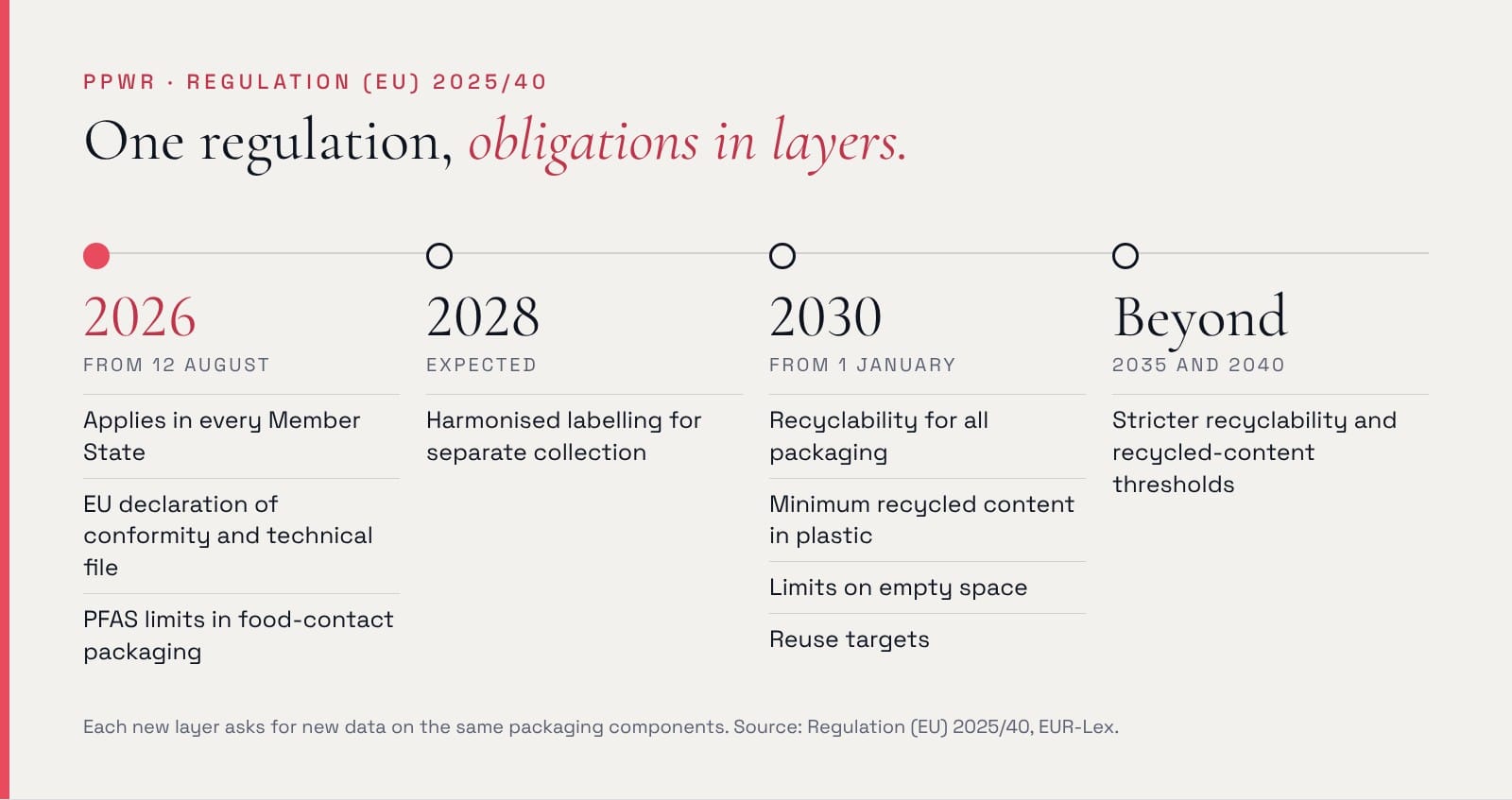
Each new deadline asks for new data on the same components. A system built on the real structure of the products can be extended; a set of temporary fixes has to be rebuilt every time.
Process first, technology second
We started from one question: what path does a piece of data follow, from the supplier’s document to a declaration ready for signature? We mapped every step, every responsibility and every point where information can be lost or change meaning. Only then did we choose the tools. A company that understands its own process adopts less technology, and uses it more precisely.
Who does what: AI, rules and people
Thinking belongs to people: giving meaning, choosing, answering for the consequences. Reasoning over large volumes of data is what machines do best. Thomas Malone calls the intelligence that emerges from people and machines working together a supermind.1 In a regulated process this becomes a precise division of labour.
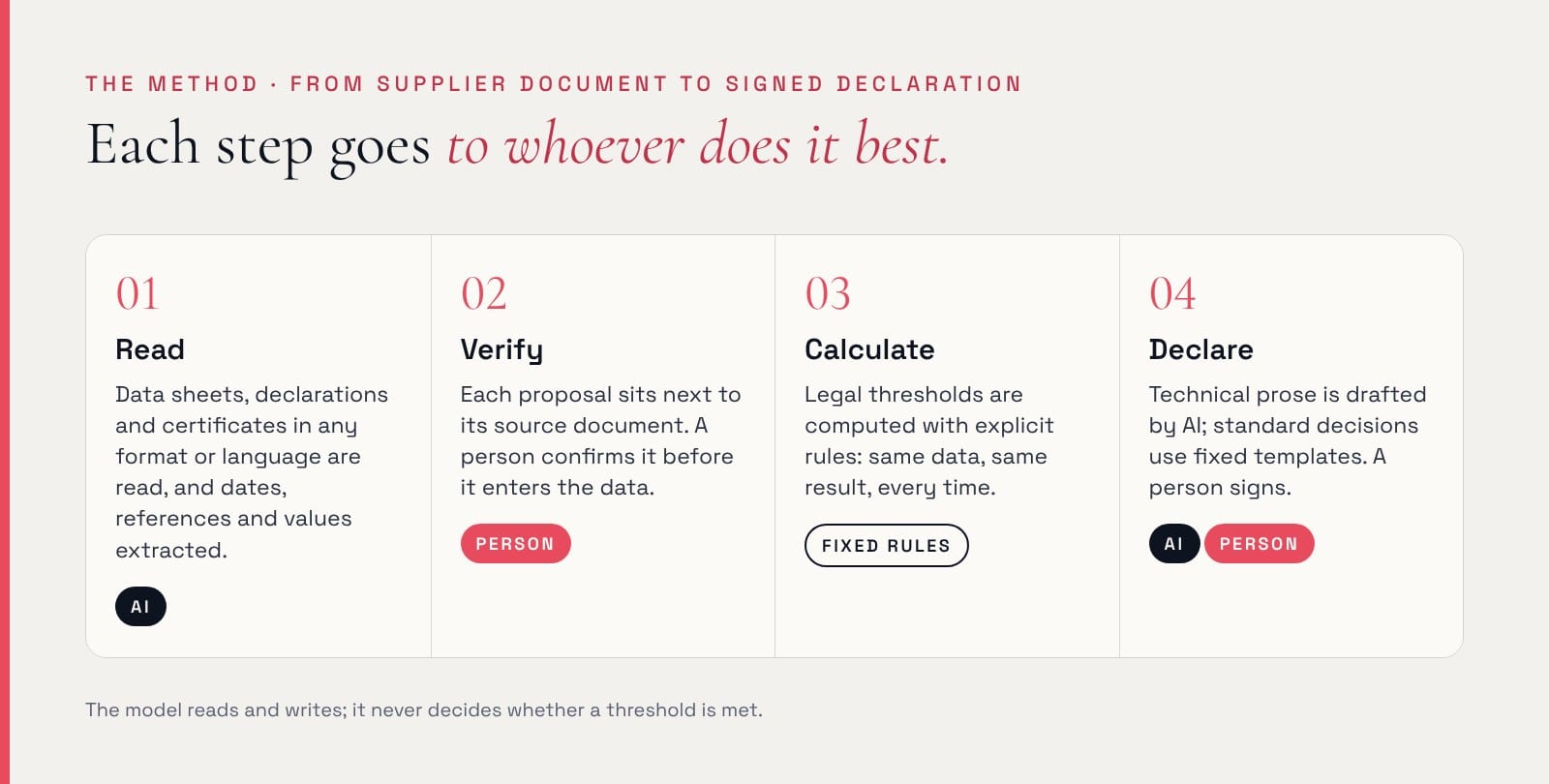
Two choices matter most. Verification is never a formality: research on automation bias shows that people tend to accept automated output without enough scrutiny,2 so the interface puts each proposal next to its source and asks for explicit confirmation. And thresholds never go to the model: language models are probabilistic, while a legal check must give the same result for the same data, every time.
This, for us, is AI strategy: knowing where artificial intelligence produces verifiable value, and where it would only add uncertainty.
What the company gets
- A live map of gaps, classified as blocking, high or informational.
- Traceable decisions, with technical findings kept apart from business choices.
- Repeatable declarations, produced with a method anyone can check.
- Evidence on demand for customers, partners and authorities.
The service: Packaging Compliance
Packaging Compliance is open to any company placing packaged products on the European market: food and beverage, cosmetics, pharmaceuticals, manufacturing.
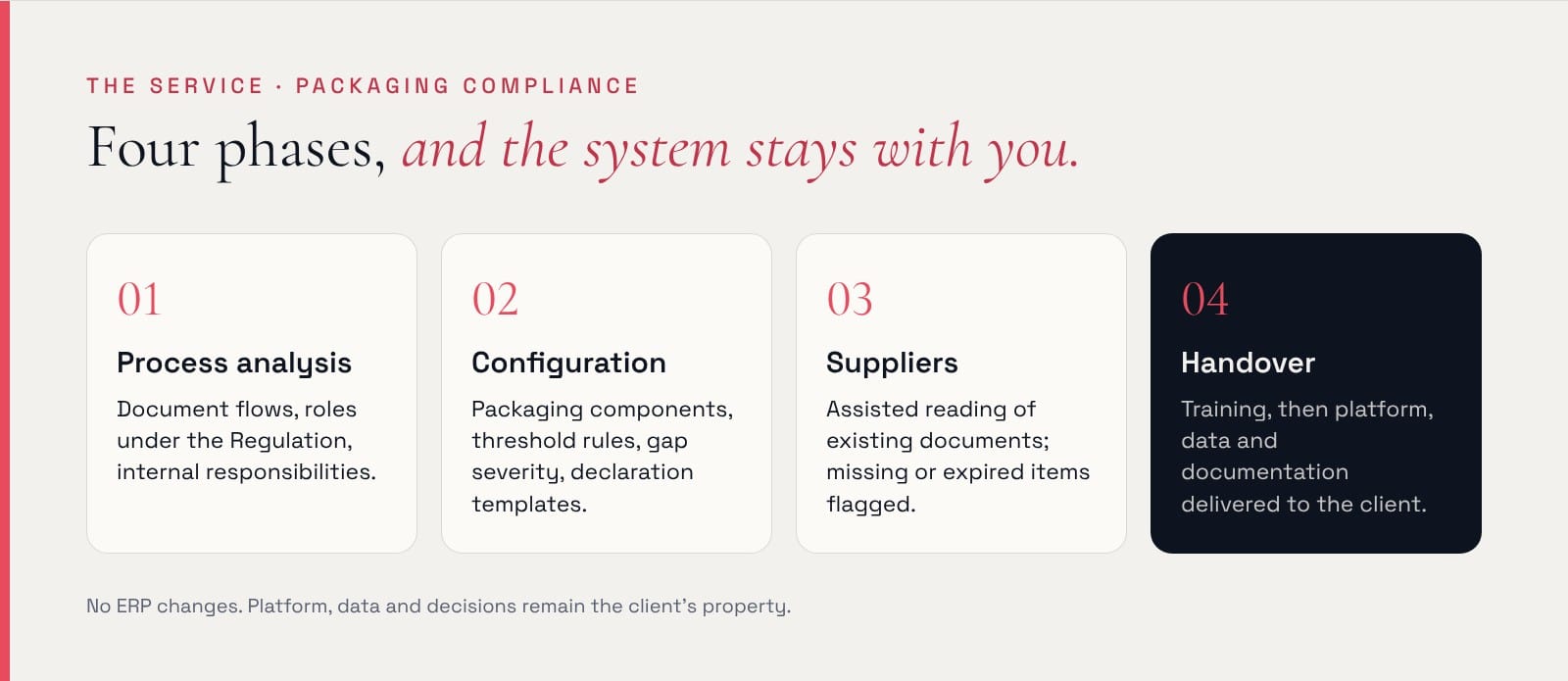
The platform, the data and the decisions stay with the company, and nobody depends on us for every future change. As a Società Benefit, we see the client’s autonomy as an outcome of the project. The same method works for any regulated process spread across several functions and sources.
Facing a regulatory obligation or a document-heavy process? In a first conversation we establish where AI helps, where it does not, and which phase to start from. Write to innovation@adsiderius.com.
Frequently asked questions
Does the PPWR apply to my company?
Can AI handle compliance on its own?
Do we need to change our ERP?
What about the deadlines after 2026?
Project card. Client: Distilleria Zanin 1895 · Regulation: (EU) 2025/40 (PPWR) · Year: 2026 · Scope: process analysis, compliance platform, assisted document reading, deterministic threshold rules, declaration drafting · Service: Packaging Compliance · The distillery: distilleriazanin.it
Compliance you can prove. Tell us about your process: innovation@adsiderius.com
Siderius S.r.l. Società Benefit · Via Roma 50, 36070 Trissino (VI), Italy · adsiderius.com
Sources and references
- Malone, T. W. (2018). Superminds: The Surprising Power of People and Computers Thinking Together. Little, Brown and Company.
- Parasuraman, R., Manzey, D. H. (2010). Complacency and Bias in Human Use of Automation: An Attentional Integration. Human Factors, 52(3), 381–410. doi.org/10.1177/0018720810376055
- Regulation (EU) 2025/40 on packaging and packaging waste. EUR-Lex. eur-lex.europa.eu
- Assolombarda. PPWR, dal 12 agosto in applicazione il nuovo regolamento UE sugli imballaggi (in Italian). assolombarda.it