
V per Vedetta: why online scams work on everyone
Digital scams exploit cognitive mechanisms common to everyone. V per Vedetta is Siderius's free platform for checking a suspicious message before acting on it.

Benefit project · Siderius
Paste a suspicious message, know in seconds if it is a scam. Free, for everyone.
- Project
- A common-benefit project of Siderius S.r.l. Società Benefit
- Where
- vpervedetta.it, App Store and Google Play
- Principle
- The machine detects first; the person decides.
A text message at seven in the evening: “Your parcel is on hold, pay €1.99 within 24 hours.” A WhatsApp from an unknown number: “Hi Mum, I’ve lost my phone, I need an urgent transfer.” A call from a self-styled fraud officer who knows your name and asks you to move your balance to a “safe account”.
The image of the elderly, inexperienced victim is misleading. The same techniques reach the accounts clerk whose supplier has “changed its IBAN”, and the customers of major banks, imitated down to the logo and the login page. They reach well-informed people, at the moment they are in a hurry. In 2025 digital fraud took €269 million from people in Italy, 17.4% more than the year before, across 27,085 confirmed cases: cases are stable, the amount per incident is rising, and the figure counts confirmed cases only.1
Why scams work
A well-built scam does not rely on naivety. It relies on mechanisms everyone shares: decisions taken in seconds lean on fast intuition, which errs more often;2 requests in a trusted name lower our guard;3 and fear and urgency do the rest.4
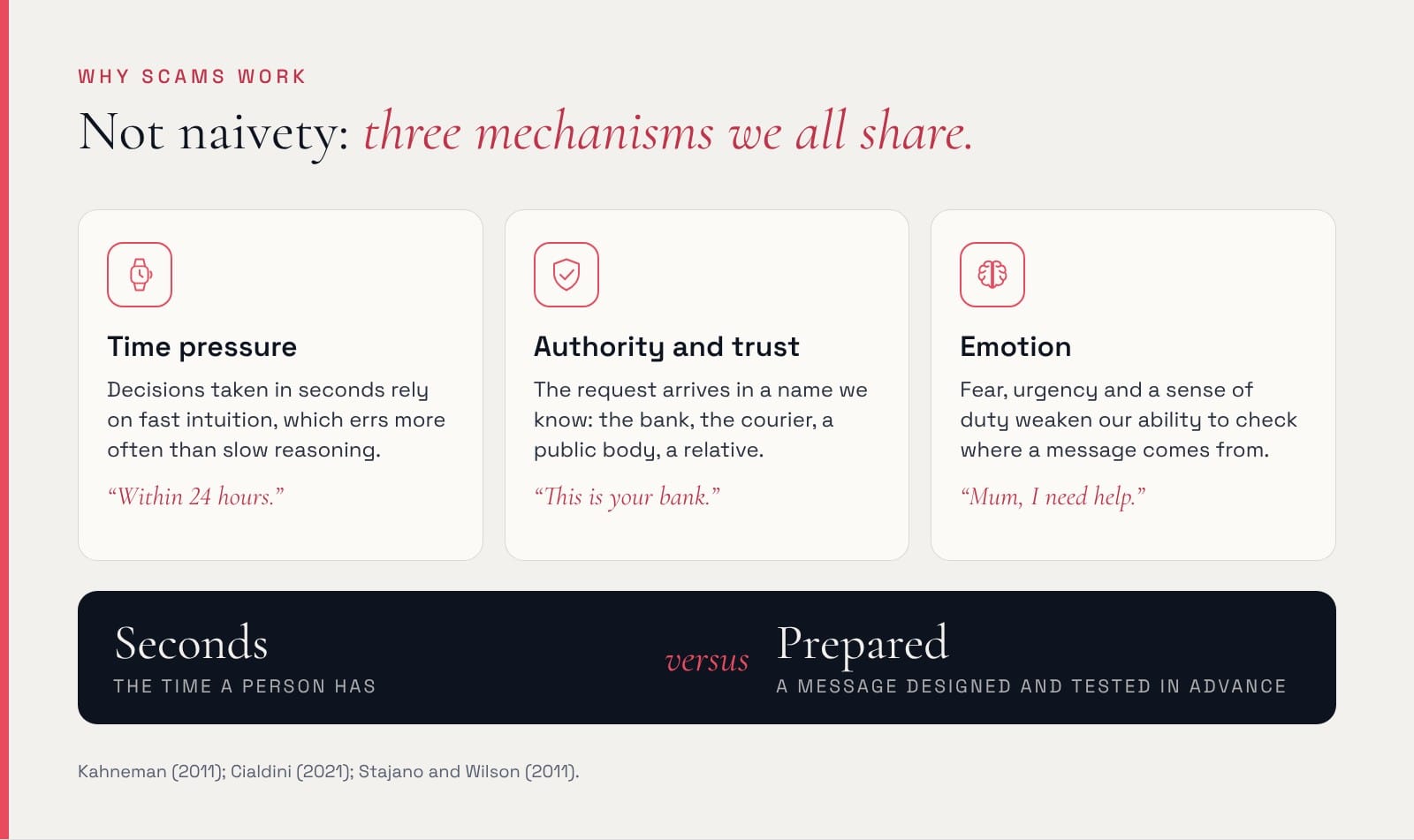
Faced with the message, the person is alone, with a few seconds, against someone who designed and tested it. V per Vedetta was created to reduce this asymmetry.
How it works
Paste the message into vpervedetta.it or the app, and within seconds you know whether it is a scam already reported, which signals give it away and what to do.
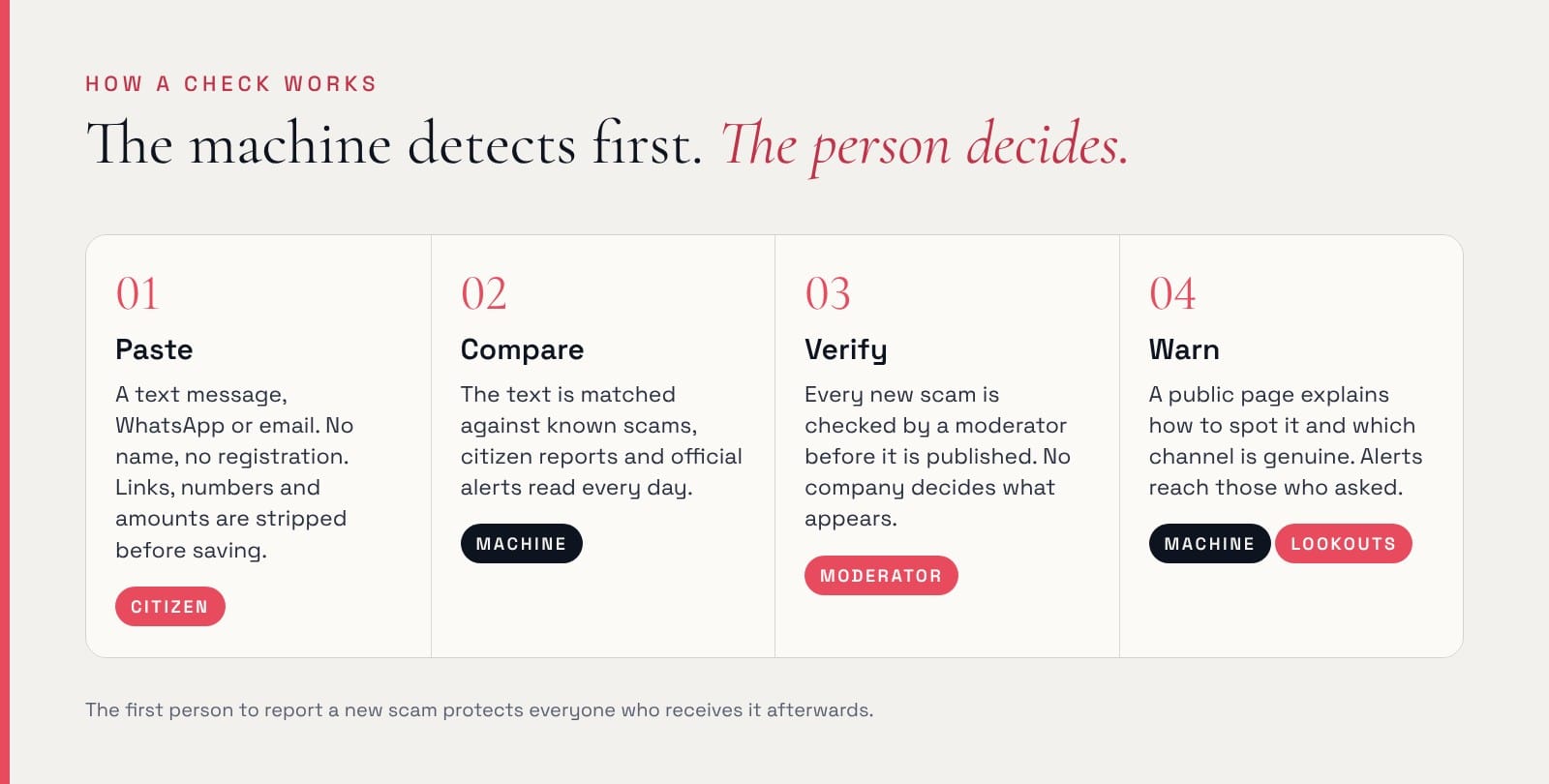
It is the same principle Siderius applies everywhere: the machine reads official alerts every day, compares thousands of messages and spots patterns; a person verifies every scam before it goes public. And data is worth something only when it protects someone: if a hundred people report the same message, Vedetta warns the next before they reply, keeping only the minimum needed.
The tools
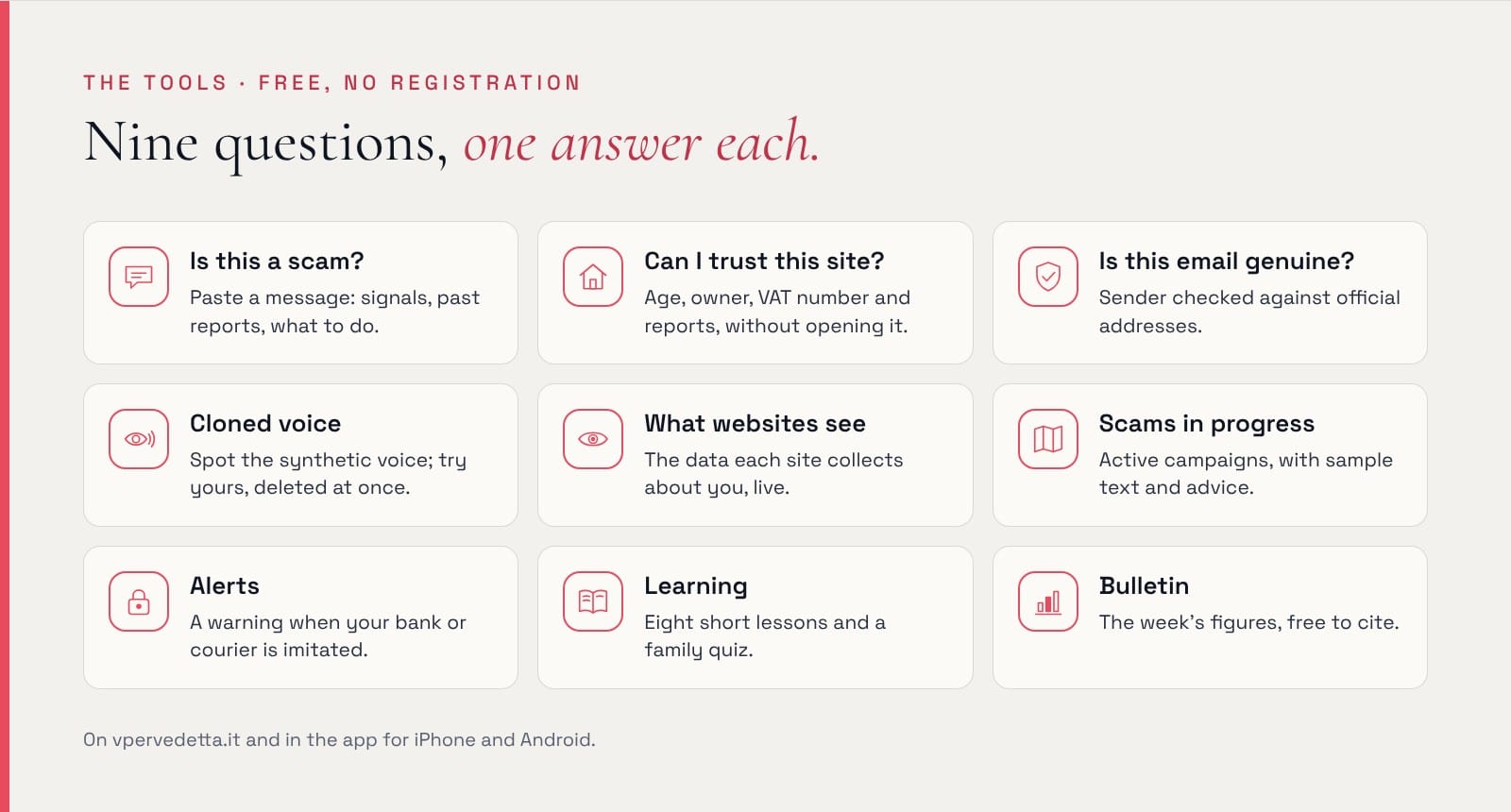
The cloned-voice test deserves a word: a few seconds of a voice message are enough to imitate someone. On explicit request you can try it with your own voice, which says one fixed sentence and is deleted at once. Experiencing it safely is the best way to learn to recognise it.
How data is handled
- No identity needed. Checking a message asks for no name, email or phone number.
- Text cleaned before saving. Links, numbers and amounts are removed; reports are anonymous.
- No tracking, no ads. No third-party cookies; statistics are aggregate and processed in-house, with a one-click opt-out.
- Deletable at any time. Alerts need only an email, never shown, with passwordless access.
The full policy is on the privacy page, in plain language.
Free, and sustainable
Vedetta sells no subscriptions, no advertising and no personal data. This is possible because Siderius is a Società Benefit, a company that writes common-benefit objectives into its articles of association and answers for them,5 and Vedetta is one of its common-benefit projects. It is sustained by companies and organisations that want to know when a scam uses their name: they receive aggregate statistics and defensive tools, never people’s data.
The lookouts
A vedetta is a lookout: someone who checks and reports a suspicious message instead of simply deleting it. The first to spot a new scam protects everyone who receives it next. Points, ranks from deckhand to admiral and weekly missions keep the network active; a map lights up a lighthouse in each municipality where a lookout is, showing only a number, never a name.
For companies, banks and public bodies
When someone impersonates an organisation, its customers often notice first. Any organisation can report fake messages, sites or profiles in its name, free and without registration; a moderator verifies, the scam gets a public page and the alert reaches those who asked. Organisations that request access also get alerts on new scams using their name and a reserved area with aggregate data. Only aggregate data and technical indicators are shared, and no organisation decides what is published. More at vpervedetta.it/per-le-aziende.
Start with the next suspicious message. Paste it into vpervedetta.it before replying, and share the link with those who receive the most: parents, colleagues, friends. Companies and partners can write to innovation@adsiderius.com.
Frequently asked questions
Is it really free?
Yes, for every citizen, always. No subscriptions, no ads, no data sold.
Do you keep the message I paste?
Only a cleaned version, without links, numbers or amounts, so the same scam can be recognised when it reaches someone else.
I’ve already lost money. What should I do?
Call your bank immediately and file a report with the Polizia Postale. Vedetta helps prevent scams; it does not replace the authorities.
Can my company take part?
Yes. Report scams in your name for free, or request access for alerts and aggregate data on the companies page.
Project card. Project: V per Vedetta · Type: common-benefit project of Siderius S.r.l. Società Benefit · Year: 2026 · Scope: scam checks, moderation, alerts, education · Access: free, no registration · Web: vpervedetta.it · App: App Store and Google Play · For organisations: vpervedetta.it/per-le-aziende
Become a lookout. Partnerships and joint projects: innovation@adsiderius.com
Siderius S.r.l. Società Benefit · Via Roma 50, 36070 Trissino (VI), Italy · adsiderius.com
Sources and references
- FABI (Italian bank employees’ federation), study on digital fraud in Italy, September 2026; reported by Teleborsa, 24 September 2026 and Money.it (in Italian).
- Kahneman, D. (2011). Thinking, Fast and Slow. Farrar, Straus and Giroux.
- Cialdini, R. B. (2021). Influence: The Psychology of Persuasion, new and expanded edition. Harper Business.
- Stajano, F., Wilson, P. (2011). Understanding Scam Victims: Seven Principles for Systems Security. Communications of the ACM, 54(3), 70–75. doi.org/10.1145/1897852.1897872
- Law of 28 December 2015, no. 208, art. 1, paragraphs 376–384 (Società Benefit).