
FlyOver: conquering the UK with an identity-led line
How to conquer a new European market with a line built on identity: six liqueurs designed and launched in the UK in three months. Research, design decisions, the role of AI, results.
Siderius × Distilleria Zanin 1895 · Case study · Food & Beverage
Key facts
- The need. Conquering a new European market, the United Kingdom, with a line built on a strong identity of its own.
- The answer. FlyOver Original Taste, a line of six liqueurs by Distilleria Zanin 1895: Sambuca, Pistachio, Limoncello, Amaretto, Aperitivo, Aurora. Each is inspired by a vehicle and by an Italian figure who took it beyond a limit.
- Timing. Three months from concept to launch in the United Kingdom, as the brief required.
- The method. Synesthetic Design: quantitative and qualitative research run in parallel with the design work, grounded in the cognitive sciences, with generative AI used to produce the content.
- Results. Launched in the UK within the required time. In 2026, awards at four international competitions: the Bartender Spirits Awards, Meininger’s ISW, The Tasting Alliance and TuttoFood Milano. Content production costs cut by 80%.
Distilleria Zanin 1895 is a fourth-generation distillery in the Veneto region of Italy that exports to more than fifty countries. Its need was precise: to conquer a new market with a line recognisable as its own rather than as one more Italian liqueur on the shelf.
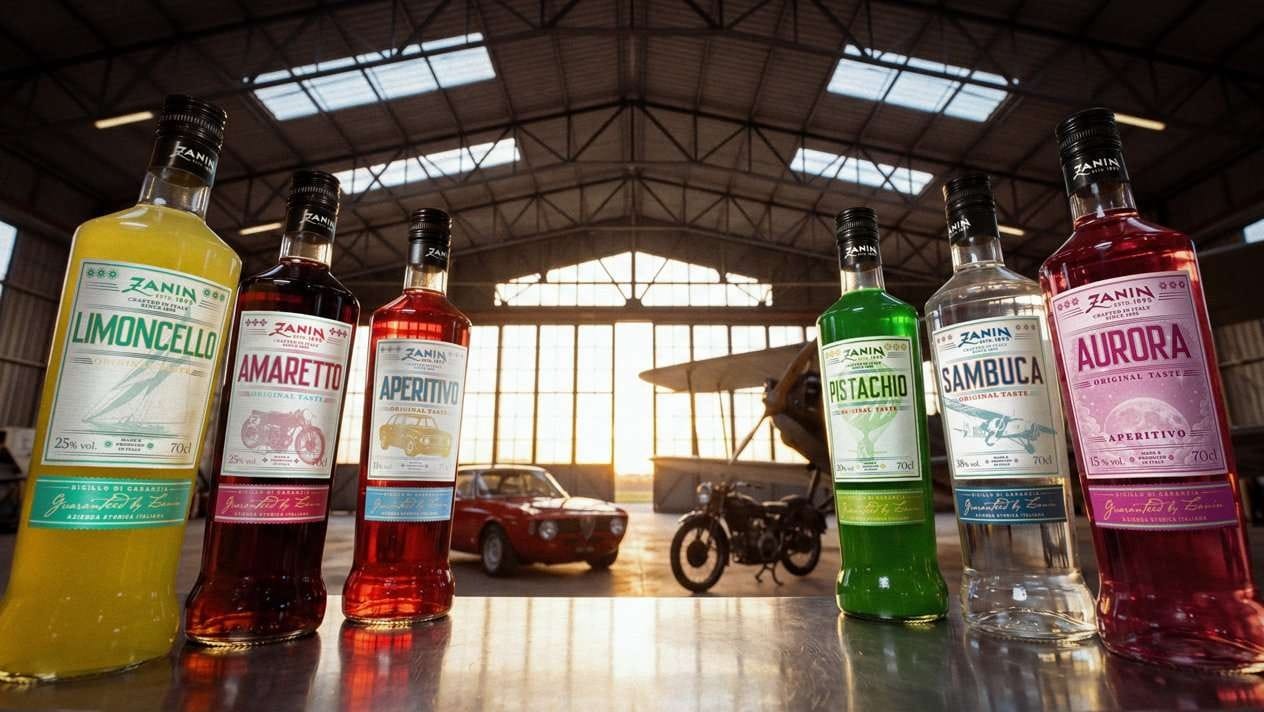
The answer is FlyOver Original Taste, a line of six liqueurs in which each bottle tells the story of a vehicle and of the person who drove it across a geographical, social or technical boundary.
This article describes the project from the inside, with particular attention to method: which data we read, which hypothesis we rejected, where we used artificial intelligence and where we chose not to. Every scientific statement refers to the sources listed at the end of the page.
What Siderius does
We work with Synesthetic Design, a design method that brings the cognitive sciences into the design of products, experiences and digital tools. Before deciding what something should be, we study how people will perceive it, remember it and choose it, reading market data together with what people say and do.
This is why our projects bring together four disciplines that are usually handed to different suppliers:
- Data and technology: market analysis, time series, predictive and language models.
- Sociological research: conversations, behaviour, cultural meaning; the qualitative data.
- Design: strategy, product, packaging, every point of contact with the audience.
- Creative work: narrative, image, content production.
Models and quantitative data make the work faster and broader. They become useful when someone interprets them in the light of what people say, do and mean. It is the same balance we look for between human work and the work of machines.
The need: a new market, and a line with an identity
Entering a new market with a liqueur means competing on a shelf where most products look alike. Zanin needed a line that British buyers would recognise and choose for its identity, not only for its flavour. The request came with three constraints.
- Time. The line had to be on the British market within three months.
- Budget. Sized for a sector in which alcohol consumption is falling.
- Audience. Reach new consumers, younger than the brand’s long-standing customers.
Three months left no room for sequential phases. Research, concept and production were carried out in parallel.
The first decision, therefore, was about method. We used artificial intelligence first of all to listen and verify, and only afterwards to produce.
Why Sambuca: a category in decline, a word to read again
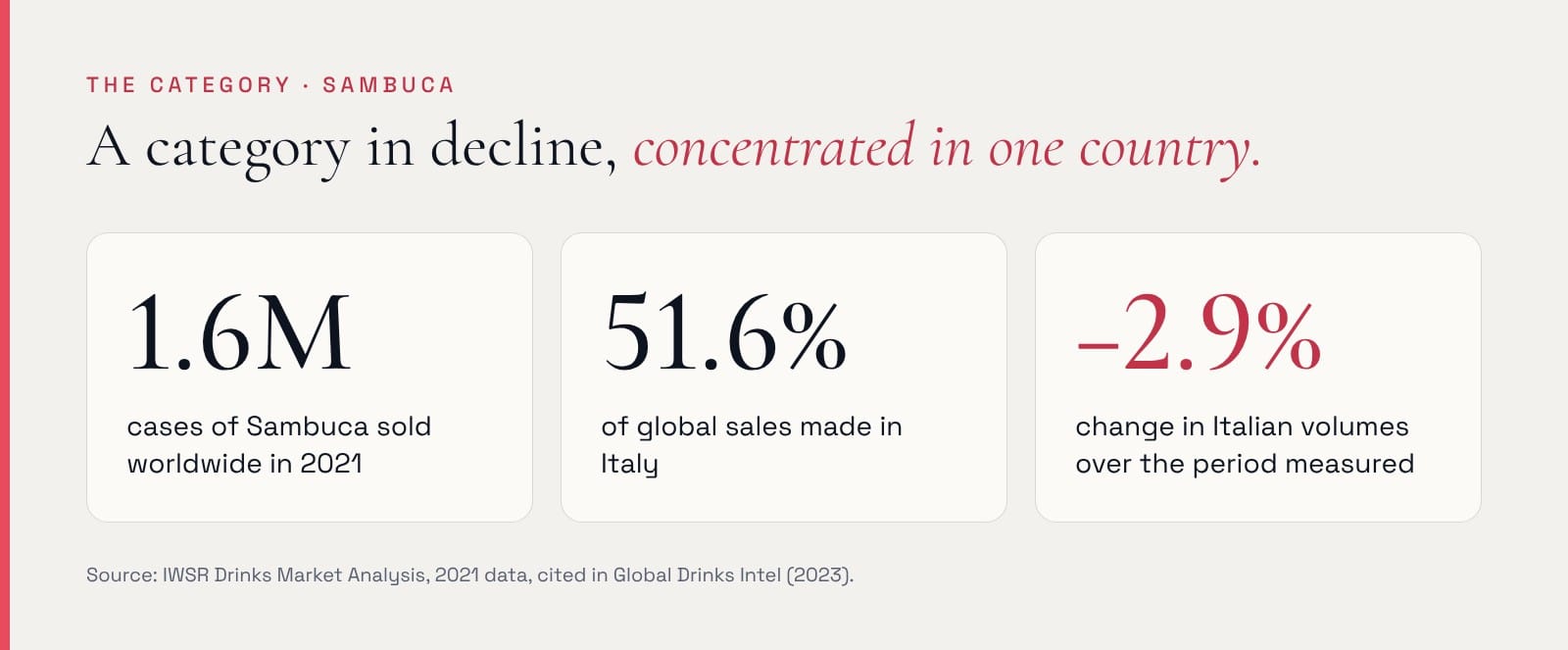
Sambuca was not an obvious choice. According to IWSR data, in 2021 the category amounted to about 1.6 million cases worldwide, 51.6% of them sold in Italy, where volumes were down 2.9%.1
Before deciding how to act, we wanted to understand whether the limit lay in the product or in the way it was perceived. We framed two questions and tested them with two different tools.
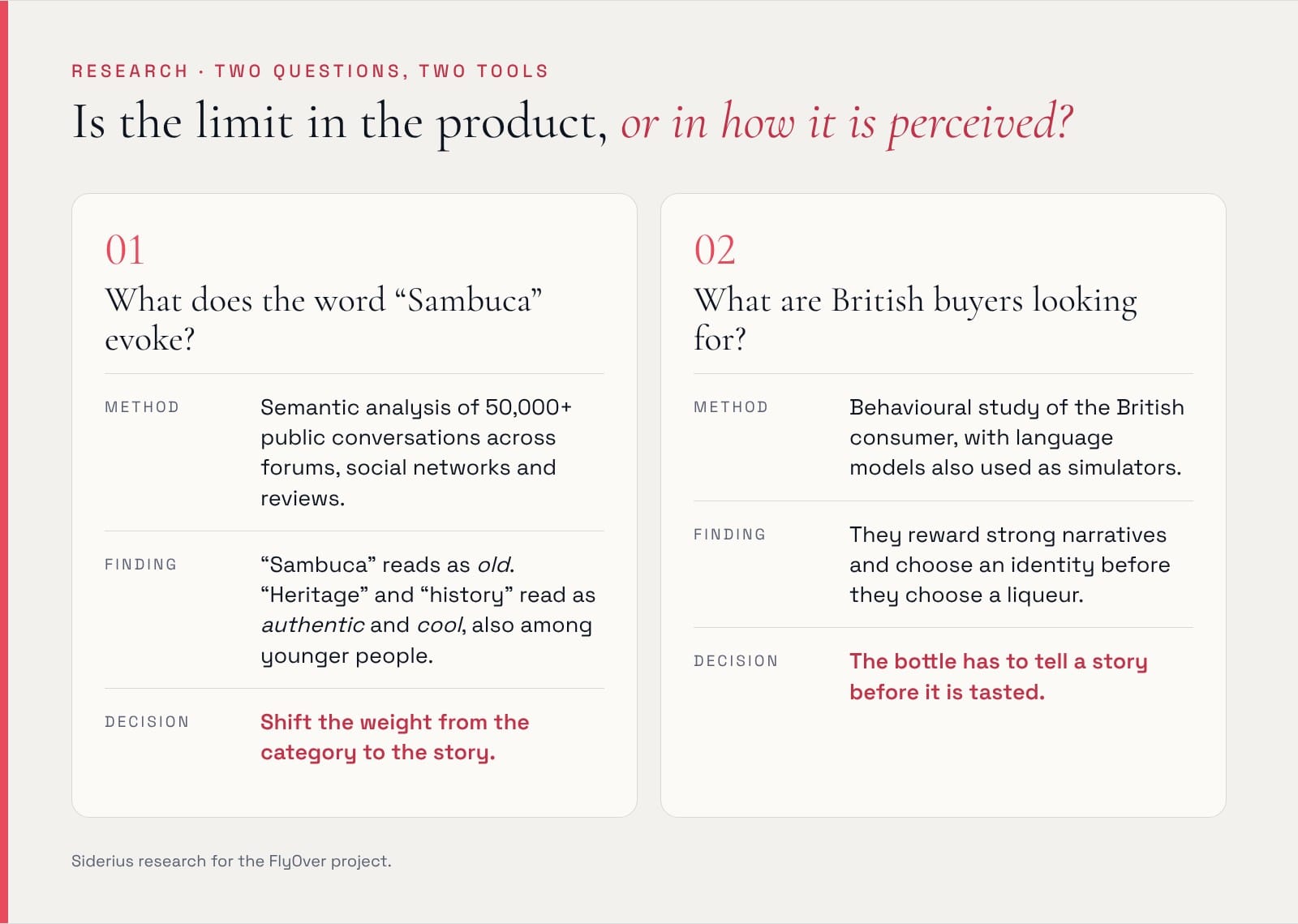
Semantic analysis measures which concepts a word is associated with, and in what tone. It is an established technique in consumer research,2 essentially netnography at scale: the study of online communities as an ethnographic field.3
For the study of the British consumer we also used language models as simulators: synthetic profiles to which we could put questions and product variants. Research shows that these models can plausibly reproduce some distributions of human opinions and preferences,45 and also that their answers can be biased and unstable.6 In our method, therefore, simulation is a tool for forming hypotheses, and it is always read alongside data collected from real people, such as the conversations analysed in the first test.
The software read fifty thousand conversations in a time no research team could sustain. Understanding what “old” means to a British audience, and why the word “history” reads as authentic, was a task of sociological interpretation.
The hypothesis we rejected, and the one we kept
Rejected: refresh Sambuca with a “young” visual language. It was the most immediate answer: a minimal label, contemporary graphics, few references to the past. The semantic analysis indicated that this would remove exactly what younger audiences associate with authenticity.
Kept: make history the raw material of the product. Research on brand authenticity identifies continuity with the past, credibility, and a connection with a place and a method of production as some of the traits people recognise as authentic.78 We therefore looked for real, documented Italian stories that could be understood outside Italy, and dedicated one bottle to each.
Six liqueurs, six vehicles, six boundaries crossed
The name FlyOver gave us the criterion. Each liqueur in the line is inspired by a means of transport and by an Italian figure who used it to go beyond a limit, whether geographical, social or technical.9 We left out the most celebrated national heroes and checked every reference against historical sources. The full line can be seen on zanin.it.
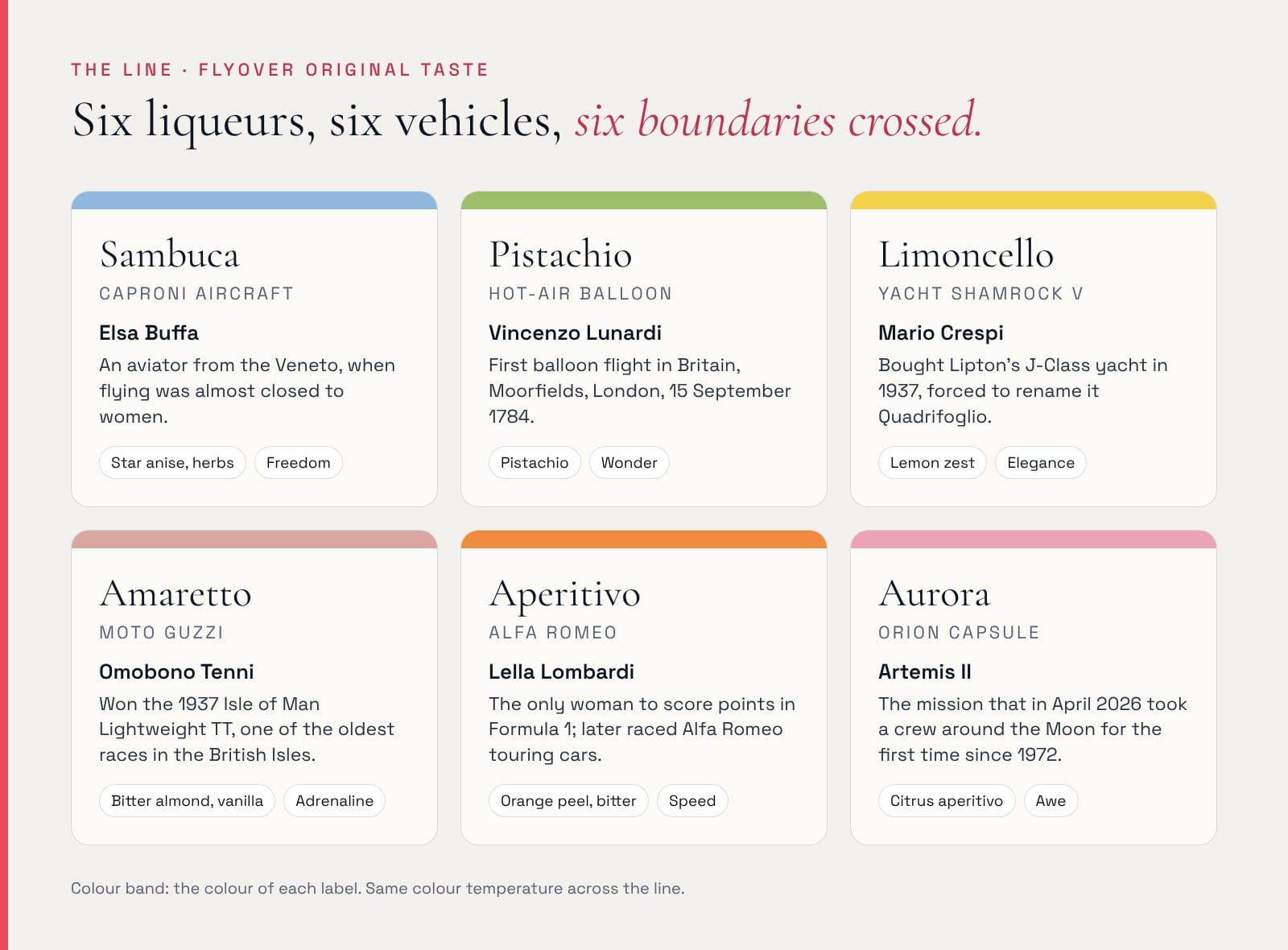
The design rule: every label must be recognisable as FlyOver before it is recognisable as a single product. The colours change from one bottle to the next while the colour temperature stays the same. A serif typeface for the name and the era, a technical sans for the data.
How a colour becomes a flavour: the scientific basis
The step from figure to bottle rests on a solid body of research on crossmodal correspondences: associations between different senses that most people share, such as the link between certain colours and certain flavours, or between shapes and tastes.1718 The colour of a drink, for example, affects both how its flavour is identified and how intense it seems.19
To explain these effects we use the framework of predictive coding: the brain continuously anticipates what it is about to perceive and corrects its prediction according to incoming signals.2021 With a product, the label, colour and name create an expectation that shapes the tasting experience.22 The effect has also been observed at the neural level: in a study published in PNAS, the same wine presented with a higher price produced greater activity in brain areas associated with pleasure.23
This is the basis of the principle of multisensory congruence that guided the six bottles: colour, aromatic profile and story have to confirm the same expectation. Neuroscience describes cases in which integrating congruent signals produces a response greater than the sum of the individual stimuli, especially when those stimuli are weak,24 and in sensory marketing congruence between stimuli is associated with more favourable product evaluations.25
Where AI did the work, and where it did not
With six products, three months and a careful budget, a traditional photo shoot would have absorbed too large a share of the resources: locations, permits, casting, shipping the products, post-production. We therefore generated the settings with generative AI and composited photographs of the real bottles into them. The bottles themselves were never recreated artificially.
The production cycle went from about four weeks to 20 days, and costs fell by 80%. The money saved was moved into media buying.
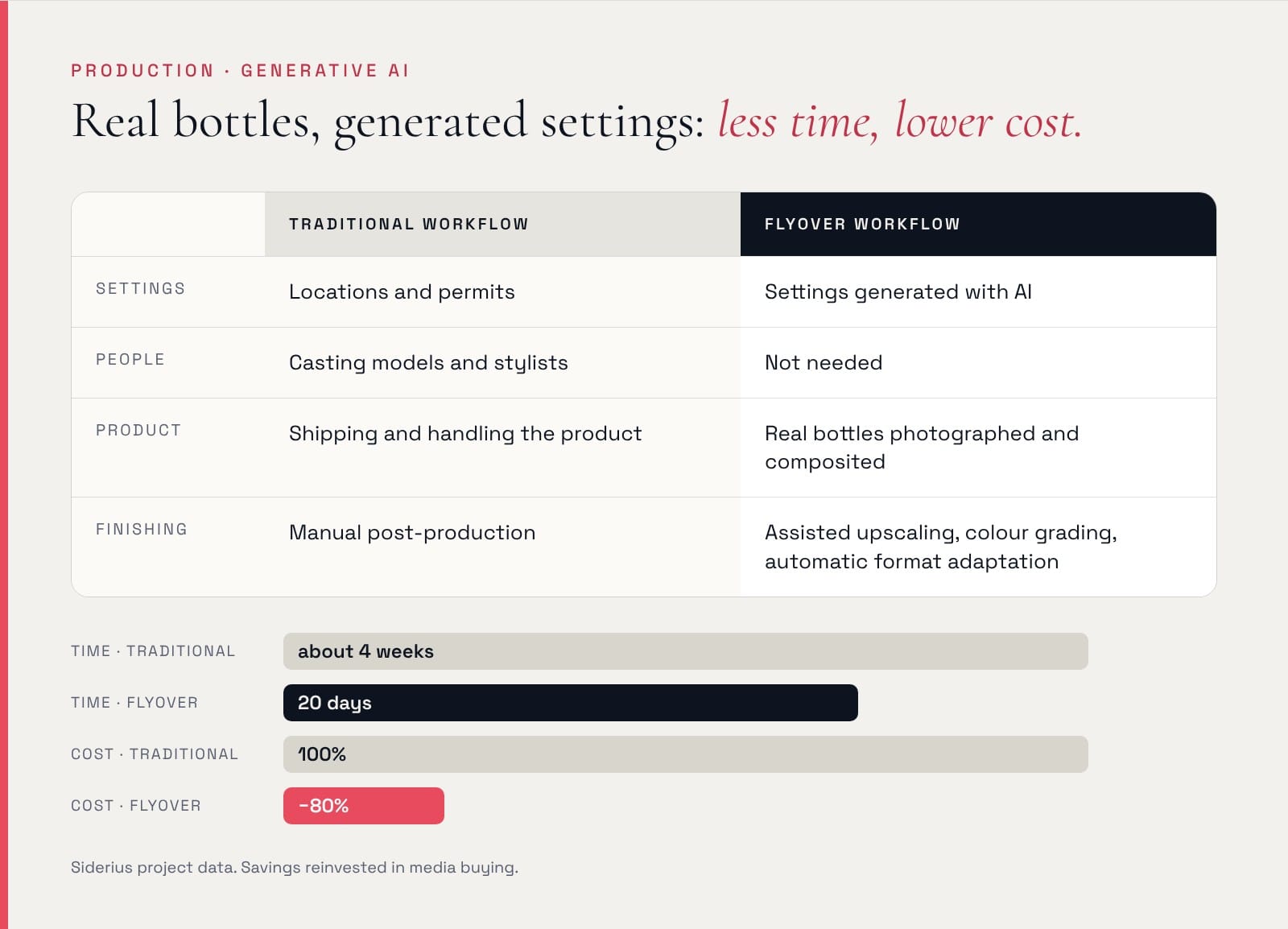
What the machine did: semantic analysis of online conversations; trend analysis of market data; simulations on synthetic consumer profiles; fast variants and prototypes of labels and visuals; settings, upscaling and adaptation to formats.
What stayed with the team: interpreting the qualitative data; choosing the figures and checking history against sources; brand decisions and the rules of the visual system; final approval of every piece of content.
This division of labour is consistent with early evidence on working with generative AI. In an experiment with 758 Boston Consulting Group consultants, GPT-4 improved speed and quality on tasks within the model’s reach, while on tasks outside it the likelihood of reaching the correct answer fell by 19 percentage points.26 The authors describe a “jagged frontier”. Much of our work consists in understanding, case by case, which side of that frontier a task falls on.
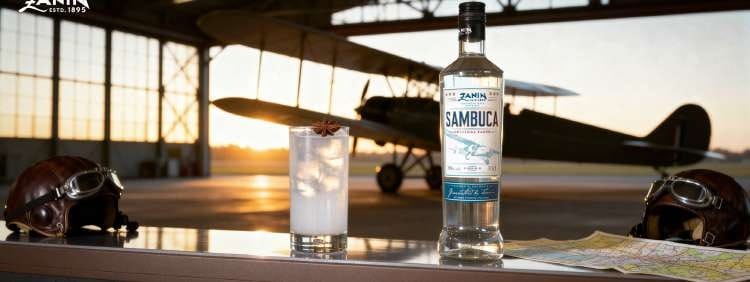

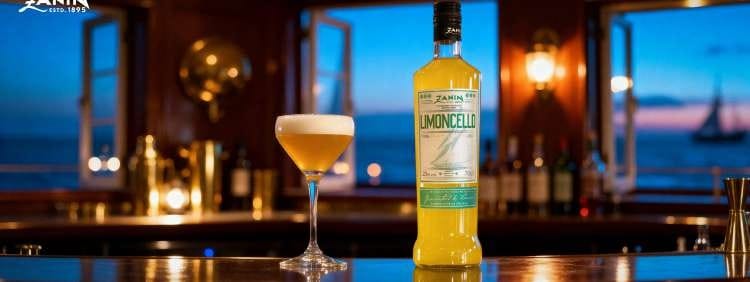
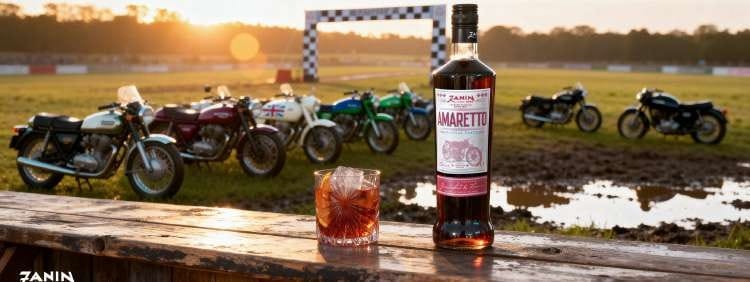
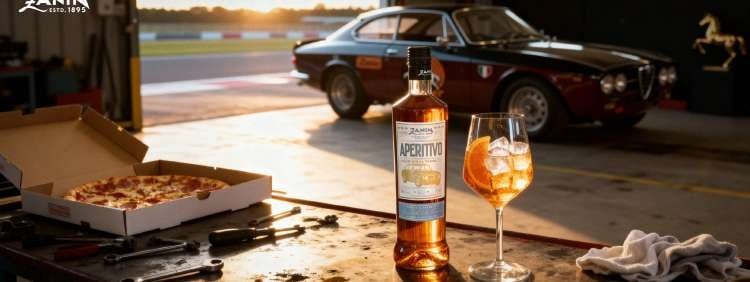

Settings generated with AI; bottles photographed and composited.
Results: the verdict of four international juries
Zanin’s request concerned the United Kingdom, and the line reached the British market within the three months set by the brief.
To assess the project we look first of all at international awards, because they are an external and independent judgement. In 2026 FlyOver products were awarded at four competitions with different juries and criteria: three assess the liquid, the fourth the innovation of the product as a whole. Four of the six liqueurs received at least one award, Pistachio and Sambuca at two different competitions, and the whole line was recognised for product innovation.
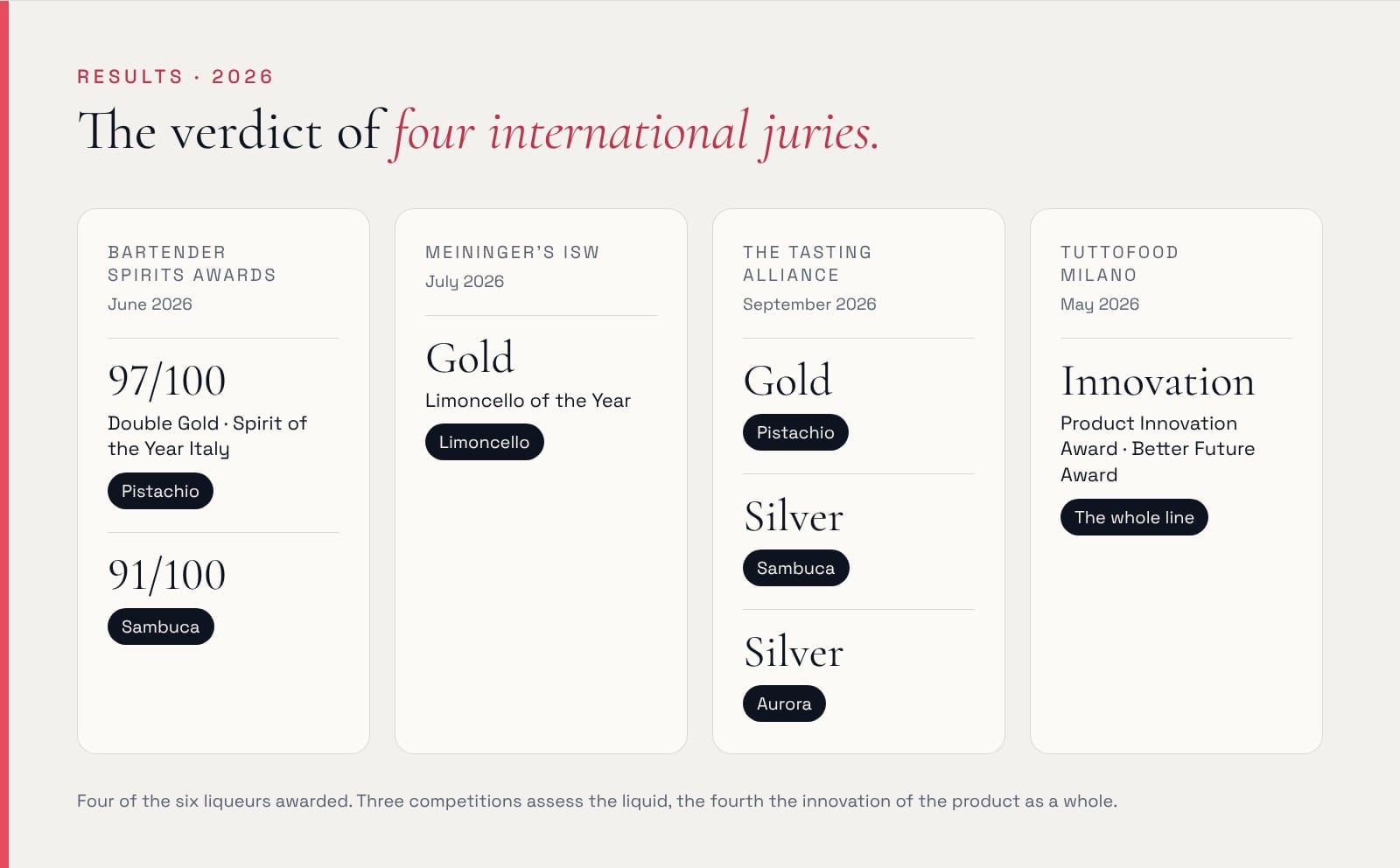
Awards alone do not prove commercial success. They do confirm that the product and presentation choices convinced expert, independent assessors, which is consistent with the hypothesis we started from: Sambuca’s limit lay in the way it was perceived rather than in the product.
What remains to be verified
Awards are qualitative evidence. Turning them into market evidence requires measurements we will follow over the coming months.
- How do the awards translate into sales over the medium term, measured on sell-out data?
- Does the same system work in later markets, with different audiences and cultural codes?
- How well is the brand remembered? We will measure it with a structured test on a declared sample.
Three rules we take into the next projects
Start from the data. The direction of the project came from analysing how people talk about the category, before any creative intuition. We asked AI to help us analyse a problem, not to invent an idea.
Use AI where it accelerates. It works on large volumes, recognises patterns and generates variants in minutes. Strategy, nuance and brand coherence remain the team’s responsibility, in a system where people and machines think together.32
Design product and communication together. Name, flavour, colour and story were born in the same workshop. Buyers perceive that coherence as quality, even when they cannot describe it.
Frequently asked questions
Is Synesthetic Design only for food and beverage?
Can a company use AI without losing its identity?
Can simulations on language models replace market research?
Does the approach work for other markets?
Project card. Client: Distilleria Zanin 1895 · Line: FlyOver Original Taste, 6 products · Launch market: United Kingdom · Year: 2026 · Scope: quantitative and qualitative research, semantic analysis, Synesthetic Design, packaging, generative AI production · The distillery: distilleriazanin.it · The liqueurs: zanin.it
A line that is remembered. Tell us about your project: innovation@adsiderius.com
Siderius S.r.l. Società Benefit · Via Roma 50, 36070 Trissino (VI), Italy · adsiderius.com
Sources and references
- Global Drinks Intel (2023). How an image refresh has revived sambuca. IWSR Drinks Market Analysis data. drinks-intel.com
- Humphreys, A., Wang, R. J.-H. (2018). Automated Text Analysis for Consumer Research. Journal of Consumer Research, 44(6), 1274–1306. doi.org/10.1093/jcr/ucx104
- Kozinets, R. V. (2002). The Field Behind the Screen: Using Netnography for Marketing Research in Online Communities. Journal of Marketing Research, 39(1), 61–72. doi.org/10.1509/jmkr.39.1.61.18935
- Argyle, L. P., Busby, E. C., Fulda, N., Gubler, J. R., Rytting, C., Wingate, D. (2023). Out of One, Many: Using Language Models to Simulate Human Samples. Political Analysis, 31(3), 337–351. doi.org/10.1017/pan.2023.2
- Brand, J., Israeli, A., Ngwe, D. (2023). Using GPT for Market Research. Harvard Business School Working Paper 23-062. aiinstitute.hbs.edu
- Bisbee, J., Clinton, J. D., Dorff, C., Kenkel, B., Larson, J. M. (2024). Synthetic Replacements for Human Survey Data? The Perils of Large Language Models. Political Analysis, 32(4), 401–416. doi.org/10.1017/pan.2024.5
- Morhart, F., Malär, L., Guèvremont, A., Girardin, F., Grohmann, B. (2015). Brand authenticity: An integrative framework and measurement scale. Journal of Consumer Psychology, 25(2), 200–218. doi.org/10.1016/j.jcps.2014.11.006
- Beverland, M. B. (2005). Crafting Brand Authenticity: The Case of Luxury Wines. Journal of Management Studies, 42(5), 1003–1029. doi.org/10.1111/j.1467-6486.2005.00530.x
- Distilleria Zanin 1895. Original Taste: la linea Zanin nata per sfidare gli orizzonti (in Italian). distilleriazanin.it
- Distilleria Zanin 1895. Original Taste: la linea Zanin nata per sfidare gli orizzonti (in Italian). distilleriazanin.it
- British Balloon Museum & Library. The First Aerial Voyage in Britain: 1784. bbml.org.uk
- J Class Association. Shamrock V, JK3. History of the yacht and its owners. jclassyachts.com
- Manx National Heritage, iMuseum. Omobono Tenni aboard Moto Guzzi, 1937 Lightweight TT. imuseum.im
- Formula 1. Trailblazing racer Lella Lombardi remembered, 30 years on from her death. formula1.com
- Lella Lombardi Archive. The memory of Elio Imberti, Lella Lombardi’s trainer in the European Touring Car Championship 1982–1984. lellalombardi.it
- NASA. Artemis II. Crewed mission around the Moon, 1–10 April 2026. nasa.gov
- Spence, C. (2011). Crossmodal correspondences: A tutorial review. Attention, Perception, & Psychophysics, 73(4), 971–995. doi.org/10.3758/s13414-010-0073-7
- Velasco, C., Woods, A. T., Petit, O., Cheok, A. D., Spence, C. (2016). Crossmodal correspondences between taste and shape, and their implications for product packaging: A review. Food Quality and Preference, 52, 17–26. doi.org/10.1016/j.foodqual.2016.03.005
- Spence, C., Levitan, C. A., Shankar, M. U., Zampini, M. (2010). Does Food Color Influence Taste and Flavor Perception in Humans? Chemosensory Perception, 3(1), 68–84. doi.org/10.1007/s12078-010-9067-z
- Friston, K. (2010). The free-energy principle: a unified brain theory? Nature Reviews Neuroscience, 11(2), 127–138. doi.org/10.1038/nrn2787
- Clark, A. (2013). Whatever next? Predictive brains, situated agents, and the future of cognitive science. Behavioral and Brain Sciences, 36(3), 181–204. doi.org/10.1017/S0140525X12000477
- Piqueras-Fiszman, B., Spence, C. (2015). Sensory expectations based on product-extrinsic food cues: An interdisciplinary review of the empirical evidence and theoretical accounts. Food Quality and Preference, 40, 165–179. doi.org/10.1016/j.foodqual.2014.09.013
- Plassmann, H., O’Doherty, J., Shiv, B., Rangel, A. (2008). Marketing actions can modulate neural representations of experienced pleasantness. PNAS, 105(3), 1050–1054. doi.org/10.1073/pnas.0706929105
- Stein, B. E., Stanford, T. R. (2008). Multisensory integration: current issues from the perspective of the single neuron. Nature Reviews Neuroscience, 9(4), 255–266. doi.org/10.1038/nrn2331
- Krishna, A. (2012). An integrative review of sensory marketing: Engaging the senses to affect perception, judgment and behavior. Journal of Consumer Psychology, 22(3), 332–351. doi.org/10.1016/j.jcps.2011.08.003
- Dell’Acqua, F., McFowland, E., Mollick, E. R., et al. (2023). Navigating the Jagged Technological Frontier: Field Experimental Evidence of the Effects of AI on Knowledge Worker Productivity and Quality. Harvard Business School Working Paper 24-013. ssrn.com/abstract=4573321
- Distilleria Zanin 1895 (16 June 2026). Tre premi ai Bartender Spirits Awards 2026 (in Italian). distilleriazanin.it
- Distilleria Zanin 1895 (16 June 2026). Tre premi ai Bartender Spirits Awards 2026 (in Italian). distilleriazanin.it
- Meininger Verlag (9 July 2026). The year’s best spirits honoured at the 22nd International Spirits Award. meininger.de
- Zanin 1895 (2026). Awards 2026, company awards sheet: The Tasting Alliance, September 2026.
- Distilleria Zanin 1895. Original Taste: la linea Zanin nata per sfidare gli orizzonti (in Italian). distilleriazanin.it
- Malone, T. W. (2018). Superminds: The Surprising Power of People and Computers Thinking Together. Little, Brown and Company.